



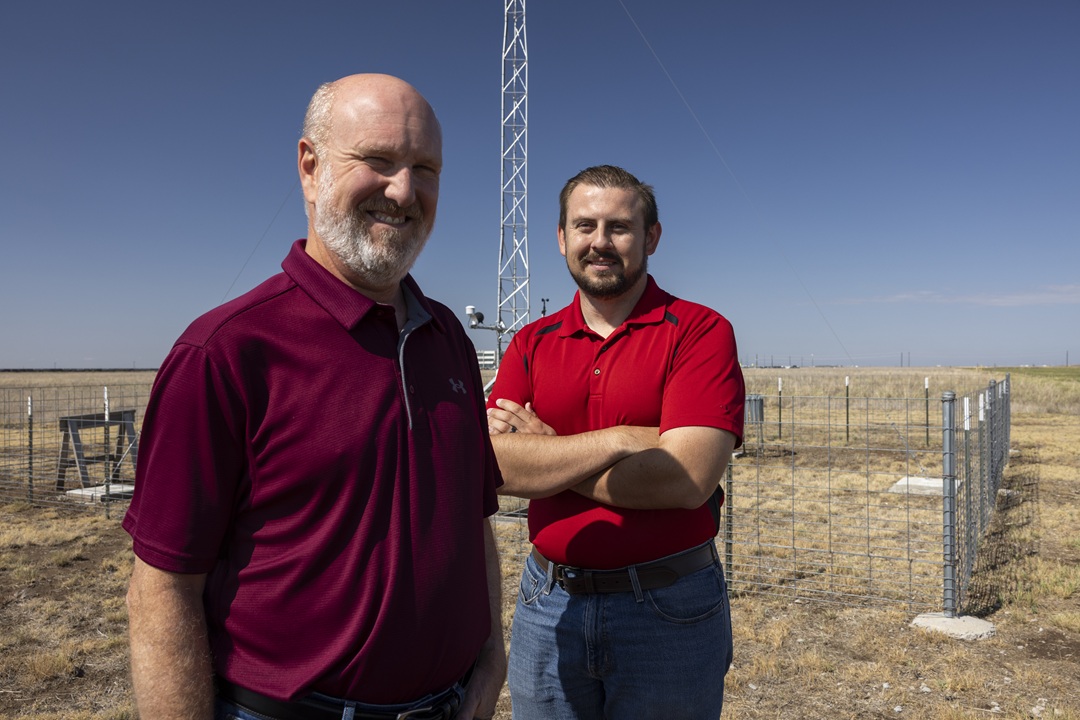
Meteorologists Steve Kersh and Corbin Voges combined have decades of local weather expertise. Photo by Adam Baker.
Reports show that in 2025, Texas recorded more than 13 million lightning flashes — the most of any U.S. state. And while Panhandle residents often welcome the rain that sometimes comes with thunderstorms, the lightning is another story. At Pantex, two on-site meteorologists work around the clock to protect the plant and its people through specialized analysis, constant monitoring, and multiple layers of redundancy.
“When I first started at Pantex in 2020, I was the only meteorologist,” Electromagnetics and Facility Engineering Meteorologist Steve Kersh said. “We were building redundant lightning systems — we only had one at the time. When that system failed, we had to scramble to get coverage back in place. Now, we’ve expanded our systems and added a second meteorologist in July of this year.”
Kersh focuses on electromagnetics, while Pantex’s new meteorologist Corbin Voges supports Emergency Management.
“I work directly with our Plant Shift Superintendent staff and the Operations Center,” Voges said. “I help establish lightning-free windows for production and support decisions when weather could prevent employees from safely getting to work — whether it’s snowstorms, wildfires, severe storms, or extreme temperatures.”
Combined, Kersh and Voges bring more than 40 years of Panhandle weather experience to Pantex — experience that matters in a region where weather changes fast. Texas’ size creates Texas-sized storms, producing high lightning count and long thunderstorm seasons. If it’s raining, chances are lightning isn’t far behind.
“Because of Amarillo’s proximity to the Sangre de Cristo Mountains and moisture from the Gulf of America, mid latitude cyclones often form right here in the High Plains,” Voges said. “We get some of the sharpest pressure gradients in the country, and this leads to that Panhandle wind many of us might despise in March and April.”
To track these systems, Kersh and Voges maintain and expand redundant weather-monitoring networks across the Panhandle. Lightning detection sites, skycams, and remote weather stations require continuous upkeep to keep production safe and ensure emergency teams have reliable, real-time data.
“We have about 94 pieces of weather equipment across the Panhandle,” Kersh said. “Sensors at places like Boys Ranch, Pampa, Clarendon, and Happy help us monitor conditions. The Happy site has been running since the early 2000s.”
Employees can also use Pantex tools to monitor weather on-site and at home. The StrikeNet app provides temperature, humidity, rainfall, wind speed and real-time lightning within 25 miles of each sensor. The Lightning Mapping Array shows cloud top electrical activity and can even detect static buildup before a lightning strike occurs. These systems benefit more than Pantex.
“Weather plays a vital role not just in our production but for our staff and surrounding communities,” Voges said. “Partnering with ranches, businesses, and other local organizations strengthens everyone’s safety. StrikeNet and our skycams support Pantex, but they also serve our neighbors.”
Pantex also hosts three West Texas Mesonet sites — east of the JCDC, on FM 683, and near Pantex Lake — providing official meteorological data to the Mesonet and the National Weather Service.
In a state where weather is always changing, the Pantex meteorology team delivers safety, preparation, and resilience. By combining advanced systems with decades of local expertise, Kersh and Voges help ensure operations continue safely — rain, wind, lightning, or shine.