News
CNS Pantex announces latest round of employee-directed community grants
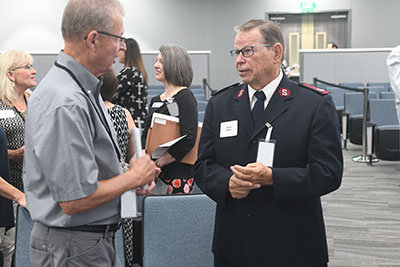
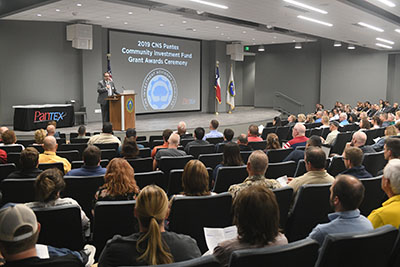
AMARILLO, Texas – Nonprofits in the Texas Panhandle will be better able to expand or continue their missions thanks to grants from Consolidated Nuclear Security’s (CNS) Pantex Community Investment Fund, administered by the Amarillo Area Foundation.
CNS, which manages the Pantex for the U.S. National Nuclear Security Administration, created an advisory committee to determine distribution of the funds. The committee prioritized the submissions from organizations located and operating in the 12 contiguous counties surrounding Pantex, which includes Armstrong, Carson, Deaf Smith, Donley, Gray, Hall, Hutchinson, Moore, Oldham, Potter, Randall and Swisher.
Including the latest round of grants, CNS has donated more than $745,000 to area non-profit organizations since 2016 through the Amarillo Area Foundation.
“Our relationship with the Amarillo Area Foundation has enabled our employees to engage in the grant process in such an effective way,” said Jason Bohne, CNS Communications and Public Affairs director. “As a company, we’re happy to partner with community organizations for the betterment of Amarillo and the Texas Panhandle—where our employees work, live, and give.”
The advisory committee selected grantee organizations based on the following funding preferences and priorities: Basic Needs, Child and Family Development, Education, Community Development, Financial Literacy, and Health and Wellness.
| Recipient Name | Purpose | Amount |
|---|---|---|
| Turn Center | Support the Augmentative Comm. Project | $10,000 |
| A World for Children | Support the Bridging the Gap program | $5,000 |
| Arrow Child and Family Ministries | Provide improved food service for children | $5,000 |
| Sharing Hope Ministry | Support the Empowering At-Risk Women program | $7,500 |
| Family Care Foundation | Support Dental Assistance | $7,500 |
| Hope Lives Here | Support Harley's Legacy program to support dogs & vets | $7,500 |
| Amarillo Children's Home | Support the First Steps to Success program | $7,500 |
| Amarillo Area CASA | Recruit, train, & retain CASA Volunteer Advocates | $5,000 |
| Catholic Charities of the TX Panhandle | Support the Youth Shelter Bus purchase | $5,000 |
| The Salvation Army | Support the Nights of Shelter program | $5,000 |
| Another Chance House | Support the Live to Work, Work to Live program | $5,000 |
| American Red Cross | Support the Home Fire campaign | $5,000 |
| Golden Spread Council, Boy Scouts of America | Support the Scoutreach Mobile Park Camp | $5,000 |
| High Plains Food Bank | Support the Rural Food Delivery Service | $5,000 |
| Buckner Children and Family Services | Support the Fostering Youth independence program | $5,000 |
| Hidden Falls Ranch | Support HFR Camper Scholarships | $5,000 |
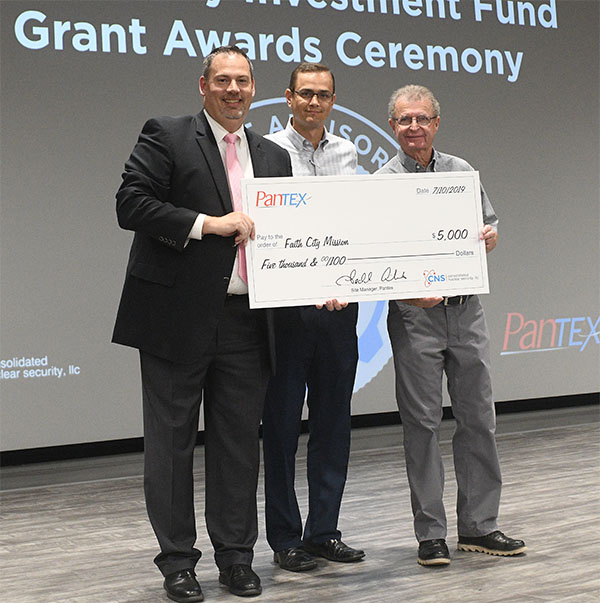
| Faith City Mission | Support basic needs for the homeless | $5,000 |
| Upbring | Support the Amarillo Foster in Texas program | $5,000 |
| Make-A-Wish Foundation | Support Wish Granting in the Texas Panhandle | $5,000 |
| Harrington Cancer and Health Foundation | Support the CMN Beads of Courage program | $5,000 |
| Transformations by Amarillo Angels | Support the Love Box/Dare to Dream programs | $5,000 |
| Claude Community Recreation | Support Claude Softball Complex construction | $2,500 |
| Don Harrington Discovery Center | Support Family Discovery membership | $2,500 |
Consolidated Nuclear Security, LLC (CNS) operates the Pantex Plant, located in Amarillo, Texas, and the Y-12 National Security Complex, located in Oak Ridge, Tennessee, under a single contract for the U.S. National Nuclear Security Administration. Pantex and Y-12 are key facilities in the U.S. Nuclear Security Enterprise, and CNS performs its work with a focus on the absolute priorities of safety, security, quality, mission delivery and cost efficiency.
For more information on each site, visit www.pantex.energy.gov or www.y12.doe.gov. Follow Pantex on Facebook, X or LinkedIn. Follow Y-12 on Facebook, X, and LinkedIn.
CONTACT
Steve Myers
Communications
Office (806) 573-0490
Stephen.Myers@pantex.doe.gov
Pantexan demonstrates Phases of Matter at Canyon Library
Pantexan Bruce Phebus with HE Materials and Testing recently presented a demonstration on the Phases of Matter to children at the Canyon Library.
Bruce talked with the children about how gasses expand and cool, the components of air, and how clouds form.
He performed demonstrations such as balloons in the vacuum chamber, the Franklin cup, and touchable clouds for the children whose average age was around 5 years old.
“I think science demos are important because science shouldn’t be abstract. It should be something people and kids realize is a real job and it explains the world,” Bruce said. “I think science without seeing scientists in person and demos is like watching water polo from the Sahara. Any given kid can’t even imagine the pool let alone someone playing in it.”
He said doing these types of demos makes science relevant for children, and explains the world that children touch and see every day.
“It isn’t just ‘facts’ in a book that are untestable and unverifiable on their own, things they just need to accept,” Bruce said. “The key tenant of science is trust but verify! Learn it all for yourself!”


Pantexan recognized with EFCOG award
Kimbel Leffew with Pantex Contractor Assurance is a member of the Human Performance Improvement Working Group team that was awarded the HPI Team Award by the Energy Facilities Contractor Operating Group at its annual meeting in Washington, D.C.
Chris Clark, Leffew’s manager, said, “As a fairly new manager in the Contractor Assurance organization, Kimbel has been a quick study of the complex processes and tools we use. With her outstanding contacts across the nuclear enterprise, she reaches out on a regular basis to benchmark other organizations as well as offer benchmark-quality ideas emanating from our two plants.”
Leffew and Chuck Ramsey (Oak Ridge National Laboratory) accepted the award on behalf of their team. The team was recognized for exceptional performance by a group who was instrumental in addressing a key EFCOG issue. The HPI Working Group turned around its team and provided members products that add value, such as a template for building an HPI strategic plan, an HPI business plan, and HPI assessment tools.
This award also recognizes the team’s contributions to the design and implementation of the HPI curriculum with the creation of the HPI Fundamentals and HPI Lead Practitioner Training Courses under the Performance and Reliability Program in DOE.
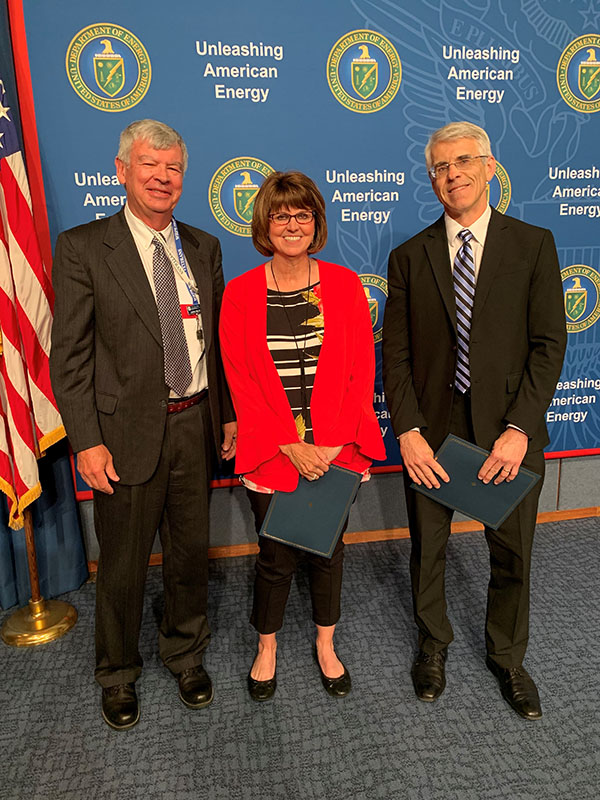
Kimbel Leffew, Pantex Contractor Assurance, and Chuck Ramsey, ORNL, accept the Human Performance Improvement Team Award from the EFCOG Safety Chair John McDonald. Team members not pictured include: Patricia Allen (Savannah River Remediation), Mike Petrowski (Los Alamos National Laboratory), and Lloyd Keith (Washington River Protection Solution).
10 Ways We Strive for Safety at Pantex
1. Protect your health
- Get checked out! An annual physical is a Cigna CNS benefit.
- Know your numbers: blood pressure, cholesterol levels, blood sugar, and body mass index.
2. Insist on Pre-Job Briefings
- Identify scope to be performed and how it will be done; discuss location and potential hazards; know what personal protective equipment is required.
- Know what to do if abnormal conditions occur.
3. Perform the DRIVER steps before operating a vehicle
- Do a 360-degree walk-around; Rely on a spotter; Identify the safety features; Verify safe conditions; Eliminate distractions; Report all accidents.
- Ask your supervisor or safety representative if you have questions
4. Set High Standards to avoid falls in the workplace
- Use ladders properly, including keeping three points of contact when climbing, not leaning to one side when on the ladder, setting the ladder at the proper angle, securing the ladder, etc.
- Ensure use of a proper fall arrest system such as full body harness, self-retracting lanyard, and approved anchor point with 100% tie-off.
5. Be Aware of Hazards in the workplace
- As you begin work, ask yourself:
- Do I have the right tools/equipment for the job?
- Have I inspected my tools/equipment to make sure they are in good repair?
- Am I positioning the tool correctly? Are hands and other body parts out of the line of fire?
- Do I need additional Personal Protective Equipment for the job?
6. Practice Hand Safety
- Our hands are one of our most valuable tools, so protect them.
- Evaluate your work area for potential hand hazards.
- Use the proper tool for the task.
- Wear the right glove for the task.
7. Commute Safely
- Driving to and from work is one of the most dangerous activities we do each day.
- Start SMART
- Secure your seat belt and adjust your seat.
- Make adjustments (check mirrors and eliminate blind spots) before putting vehicle in drive.
- Avoid driving drowsy by getting plenty of rest each night. Lack of sleep causes you to react more slowly, and impairs judgement and vision.
- Remain focused on driving.
- Thoroughly check your surroundings for traffic, people, blind spots, and objects.
- Stay SMART
- Control your Speed.
- Monitor for excessive speed and road conditions.
- Avoid distractions. Follow CNS’s Cellular Telephone/Mobile Electronic Device policy to minimize risk during driving.
- Follow the Rules of the road.
- Take Time to reach your destination. Plan ahead. Allow for extra time.
8. Walking is Working
- Keep these facts in mind when you consider talking or texting while walking:
- Texting decreases your situational awareness and limits eyes on path.
- Five seconds is the average time your eyes are not focused on the path if you are walking while texting.
- Tripping hazards could be one step ahead.
- Own the outcome, stop and take time out to talk or text.
9. Think Before You Act
- Report it, don’t ignore it – report near misses and if something doesn’t’ seem safe report it immediately.
- Always look for hidden hazards – be aware of changes around you and pay attention to detail and the task at hand.
- Keep your mind on the task – remind yourself why certain safety policies and best practices are in place and stop to think before you act – keep a safety mindset!
10. Manage Stress
- Focus on the one thing that’s always within your control: you.
- These steps will help you manage job stress:
- Take responsibility for improving your physical and emotional well-being.
- Avoid pitfalls by identifying knee-jerk habits and negative attitudes that add to the stress you experience at work.
- Learn better communication skills to improve your relationships with managers and coworkers.
POLO presents at WT Engineering Camp
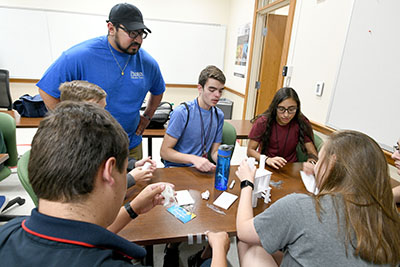
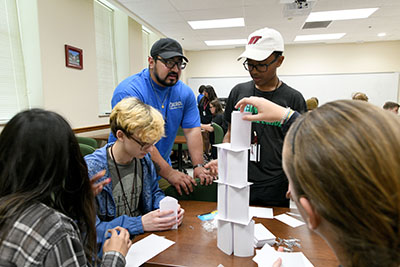
Pantexans with POLO recently took part in the annual Engineering Camp held each summer at West Texas A&M University in Canyon.
Milton Guerrero with Pantex Nuclear Procurement Engineering was a guest speaker at the event and spoke on the world of engineering and led students in an activity to help demonstrate how the world of engineering works.
Lance Duncan from Pantex Mission Engineering also presented at the event which was geared towards high school students.
During the presentations students learned about Pantex and Y-12, the different types of engineering (Mechanical, Environmental, Electrical, etc.), salary statistics, and the backgrounds of the guest speakers.
“This event was important to me because it was an opportunity to inspire kids to follow the path to becoming an engineer,” Guerrero said. “I attended this event to not only inspire but to also give back to my alma mater WTAMU.”
Recruiting for tomorrow’s workforce
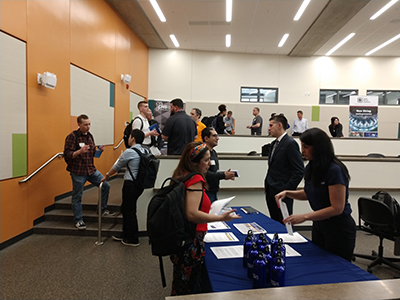
Students at several colleges recently had the opportunity to attend a Nuclear Security Enterprise Day to learn more about jobs available to them in an industry often cloaked in secrecy. During March and April, CNS, along with our colleagues from across the NSE, visited Georgia Tech, Purdue, Texas A&M, and the University of California at Merced to communicate the importance of our national security mission and the opportunities we have available for upcoming graduates.
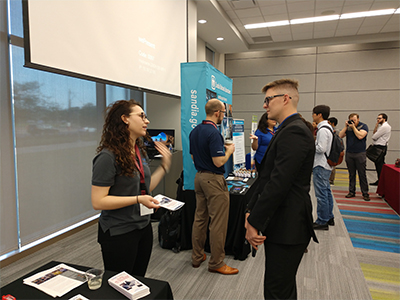 Alexi McCallick of Tooling and Tester Design at Pantex (left) talks with a student at the Texas A&M Nuclear Security Enterprise Day |
Human Resources’ Amy Moran, instrumental in recruiting and attracting top talent to CNS, noted, “In the workforce market, there is a war for talent because of our strong global economic environment. Within the NSE, we have the ‘Nuclear Security Enterprise Workforce Recruitment Strategy’ to raise awareness with universities throughout the country of what we do, the NSE mission, and our job openings.”
NSE Days include presentations, panels, and recruiting booths, allowing members of the NSE (including CNS’s Pantex and Y-12) to establish relationships with the universities. “We’re working to develop pipelines for hard-to-fill positions such as cybersecurity and engineering,” Moran said. “Pantex and Y-12 are integral to the NSE’s missions, so it’s important for us to help the enterprise attract a capable workforce to sustain our future nuclear security missions across all sites.”
Charles Herrell of Cyber Operations joined the Purdue NSE Day and thinks these events help potential employers and employees understand one another.
“I enjoyed speaking to the prospective employees for cyber security-related positions. We spoke the same language and shared a passion for protecting cyber assets,” he said. “I have been to recruiting events talking to recruiters about job openings, and they didn’t know the details of what those in my profession do, so it made me left feeling like I could not sell myself because I could see the recruiter’s eyes glaze over quickly.”
“CNS hopes to become one of the most desired places to work in the country and to fill our critical roles more quickly. This enterprise approach allows us to leverage the weight of the NSE as a whole,” she said. “As part of the NSE recruiting events, we are able to show that we are an important part of something larger than ourselves. We are contributing to the NSE recruitment strategic plan to ensure that Pantex and Y-12, and the NSE as a whole, have the workforce needed for years to come.”
2019 Presidential Migratory Bird Stewardship Award Winner
The Council for the Conservation of Migratory Birds is pleased to announce the winner of the 2019 Presidential Migratory Bird Federal Stewardship Award. The U. S. Department of Energy/National Nuclear Security Administration (DOE/NNSA) Pantex Plant was honored at this year’s Council meeting for their innovative work with Swainson’s Hawks, Purple Martins, and other birds across the Western Hemisphere. The Presidential Migratory Bird Federal Stewardship Award annually recognizes a single project or action conducted by or in partnership with a Federal agency that meets the intent and spirit of Executive Order 13186 by focusing on migratory bird conservation.
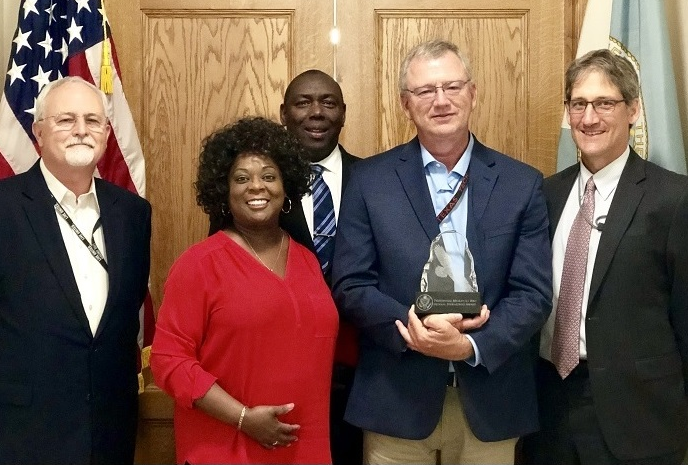
Award winners. Pictured (from left to right) are Chris Cantwell, DOE/NNSA Pantex Plant; Beverly Whitehead, DOE; Jerome Ford, U.S. Fish & Wildlife Service; James Ray, DOE/NNSA Pantex Plant; and Josh Silverman, DOE. Photo Credit: U.S. Fish and Wildlife Service
About the Winning Project
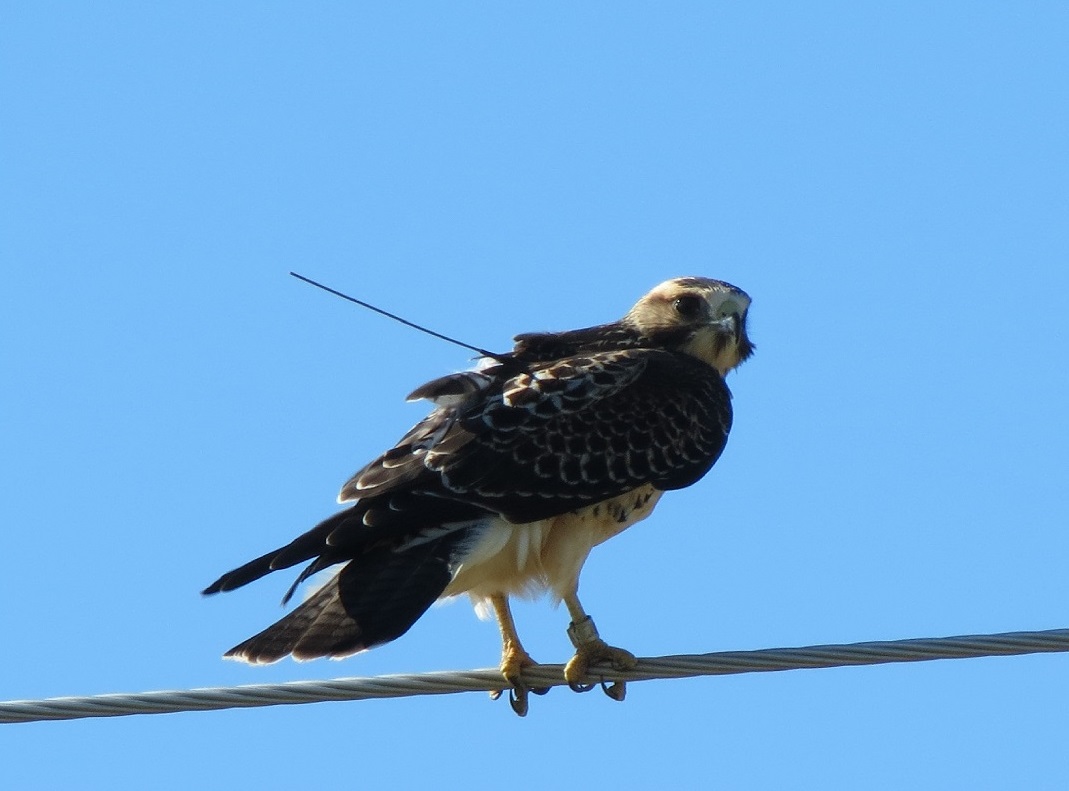
Project: Pantex-A Multi-Dimensional Approach to Contributing to Migratory Bird Conservation across Hemispheres
Project Lead: Department of Energy /Consolidated Nuclear Security, LLC (Pantex Plant)
Partners: Texas Tech University (including the USGS Texas Cooperative Fish and Wildlife Research Unit), West Texas A&M University, University of Manitoba (Canada), York University (Canada), Purple Martin Conservation Association, Disney World Wide Fund, Texas Parks and Wildlife Department, and many property owners and volunteers.
Description: The Pantex Plant increased its on-going research, collaborations, and outreach programs in 2017 and 2018. Pantex added an additional partner, the Texas Ornithological Society, which donated geolocators to Pantex staff for deployment on Purple Martins.
Pantex sponsored collaborations continued the monitoring of nine species of concern and other birds in plots associated with wind energy research (West Texas A&M University), transitioned the Swainson’s Hawk research to juveniles (Texas Tech University; including the USGS Texas Cooperative Fish and Wildlife Research Unit), and continued with analyses of data gathered on Swainson’s Hawks throughout the Hawk’s annual travels through North, Central and South America. Pantex continued to collaborate with and provide a sixth deployment site for geolocators and G.P.S. data-loggers as part of an international collaboration that has now documented and characterized core stopover regions and durations (Yucatan and Central America) and specific wintering sites of the declining Purple Martin across the Amazon Basin. The collaboration is already visiting roost sites and building relationships with managers and researchers in Brazil.
The Pantex banding and outreach program fostered continued staff participation in a graduate-level class project (Texas Tech University) which has led to a peer-reviewed journal article, the start-up of a legacy Purple Martin housing and research project for the Student Chapter of The Wildlife Society (Texas Tech University), and has now resulted in the banding of more than 12,000 Purple Martins and several publications.
Pantex continued mapping of prairie dog colonies on the facility as part of a management plan that assures preferred prairie dog-manipulated habitat for four previously mentioned special status species, including Western Burrowing Owls. During 2017 and 2018, Pantex collaborations and staff shared findings and management implications from migratory bird projects through 17 technical/conference presentations and posters, four magazine articles, three peer-reviewed journal articles, and two other scholarly articles which are in review or press.
Other agency sites continued to express interest in implementing “the Pantex research model” or collaborating with the site (Las Alamos National Lab, Y-12, Oak Ridge National Lab). As testimony to the success and respect of the Pantex program, there have been three instances of university researchers wanting to include Pantex and staff in applications for grants. Building off the successes of its contributions to migratory bird conservation, Pantex has used this successful model as a springboard for similar collaborations under the national pollinator initiative. Pantex recommendations have led to USDOE/NNSA sponsorship of a Raptor Research Foundation conference and a new purple martin colony at the Amarillo Zoo.
Considering the high-level issues, data collected, shared management implications, and on-site protection strategies, the Pantex partnership may benefit the full suite (442 species) of birds that breed in, migrate through, and winter in the Southern Great Plains. Research plot data include 28 special status species and 26 others have been documented using the site. Multitudes of bird species and individuals fly through, rest, and feed on the Pantex property during migration, and all the while they must navigate through many potential threats and an ever-growing number of wind farms. Students working on projects are graduating well-versed in migratory bird issues and advanced technology. Some, having tracked Swainson’s Hawks and Purple Martins across the Americas have already contributed to migratory bird conservation of hemispheric or global significance.
Full article can be found on the US Fish and Wildlife website.
25 years of Successful Pantex Waste Operations
Pantex Waste Operations has successfully completed its 25th consecutive Annual Resource Conservation and Recovery Act (RCRA) Waste Site Inspection with no violations, weakness or findings identified. The inspection was conducted by the Texas Commission on Environmental Quality (TCEQ) Region 1 on May 13-15.
Pat Moon, Waste Operations Department Manager said, “This is a significant accomplishment that is a result of the day to day attention to detail and implementation of compliance requirements by multiple Pantex organizations and personnel and shows a true commitment to excellence in the management of waste. Vigilance in meeting regulatory requirements and continuous improvement never ends as evidenced by our one self-reported non-compliance during the last 25 years that was related to shipment of waste to an unauthorized facility.”
Pantex’s Hazardous Waste Permit, issued by the State of Texas, authorizes Pantex to store and process hazardous and industrial waste. The inspection confirmed compliance with permit requirements and included facility walk-downs of all hazardous waste permitted locations, all less than 90-day central accumulation areas, all satellite accumulation areas, and various non-hazardous waste accumulation sites in Zone 12 South. The inspection also included a comprehensive records review to ensure compliance documentation met requirements of the Hazardous Waste Permit and applicable State and Federal regulations.
At the same time that the RCRA inspection was occurring, the TCEQ also completed a Texas Tier Two Emergency Planning and Community Right-To-Know Act (EPCRA) inspection and a Regulated Petroleum Storage Tank inspection. The EPCRA inspection was conducted to confirm that Pantex has plans and procedures in place to respond to an emergency and alert the public in the case of an event related to hazardous chemicals.
The Regulated Petroleum Storage Tank inspection was conducted to confirm that Pantex’s equipment and compliance demonstration documentation met applicable requirements and that the environment was being protected by comprehensive system monitoring. These inspections were also completed with no issues identified.
Pantex celebrates Armed Forces Day

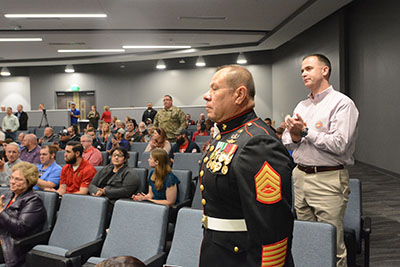
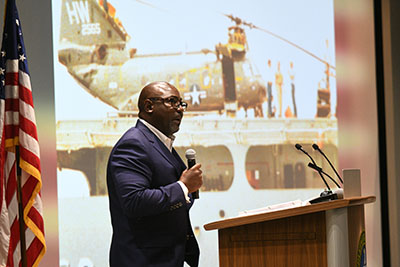
Alonzo Everhart, former Quartermaster First Class in the U.S. Navy, addressed an auditorium full of Pantex’s workforce Wednesday morning at a celebration recognizing the U.S. Armed Forces.
“Today we take time to thank our servicemen and women for preserving our freedom,” he said during the annual Armed Forces Day Celebration. “We thank them for their service, their sacrifice, and their commitment, while remembering that they need us to stand with them, and their families, while they are standing guard for us. We must continue to do our best for them, as they give their all for freedom.”
About 250 people attended the celebration at the John C. Drummond Center’s auditorium. The event was an opportunity for Pantex employees, veterans, and active duty military to show appreciation to those who have served and are still serving and remember fallen warriors.
Everhart is the senior director of Pantex Weapons Operations for Consolidated Nuclear Security, which operates the Pantex Plant and the Y-12 nuclear facility in Tennessee. He shared his story of growing up and serving in the Navy, and also spoke on his continued service to the country in his role at Pantex.
“I can imagine no more rewarding career,” he said. “And if asked what I did in my lifetime to make my life worthwhile, I will respond with a great deal of pride and satisfaction and say that I served in the United States Navy and continue to serve this great country while working at the Pantex plant.”
Bill Eckroade, the Deputy Field Office Manager in the NNSA Production Office at the Pantex Plant, shared his insights on initiatives being undertaken by the Department of Energy to support injured service members, specifically research on traumatic brain injuries utilizing the super computing systems within the DOE’s national laboratories.
Eckroade continued by sharing about the Purple Heart Trail that runs along I-40 across the U.S. from South Carolina to California. The stretch across the Texas Panhandle was the last section of the national trail to be designated.
“When the Purple Heart Trail on I-40 across the Texas Panhandle was designated, it completed the last link in a coast-to-coast national Purple Heart Trail,” he said. “Just as all roads lead to Pantex, all segments of I-40’s Purple Heart Trail led to this final stretch of highway – a stretch of highway that passes right by Pantex and the heart of our nation’s nuclear security infrastructure.”
Pantex Site Manager Todd Ailes shared that 20 to 25 percent of the Pantex’s workforce is made up of veterans and active duty military.
“Our work at Pantex is vital to national security and to our Armed Forces because our mission is to sustain a safe, secure, effective nuclear deterrent,” Ailes said. “As Pantexans, we have always taken great pride in meeting the needs of our Nation and we will forever play a part in carrying out the nuclear weapons mission.”
Wednesday’s celebration also included a tribute to prisoners of war and soldiers missing in action.
A simple, single table, known as the fallen soldier ceremony, was set up on the right side of the stage and Tori Hofeldt, former second class petty officer in the U.S. Navy, shared the symbolism behind each item on the table.
“This table, set for one, is small; symbolizing the frailty of one prisoner alone against oppressors,” she said. “The chair is empty. They are not here. We need to remember all who served with them and called them comrades. Until the day they come home: Remember.”
For more images of the celebration, please visit the Pantex Facebook site.

Pantex hosts NUWAIX 2019 exercise
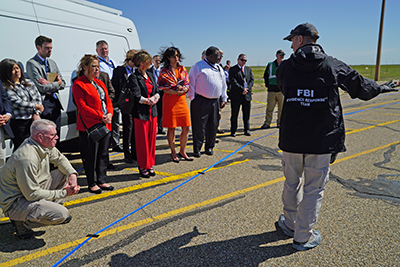
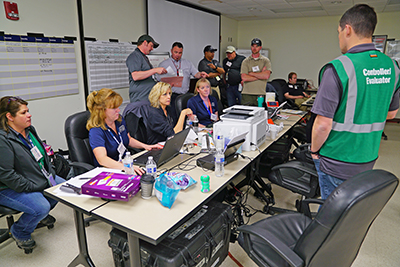
Pantexans and supporting staff from Y-12 practiced taking appropriate protective actions, activating the Emergency Response Organization, and coordinating with other agencies during the 2019 Nuclear Weapons Accident/Incident Exercise April 24-29. Hosted at Pantex, this large-scale, full-participation exercise involved numerous local, state, and federal agencies including Carson County, Amarillo Police Department, FBI, Office of Secure Transport, Texas Department of State Health Services, Environmental Protection Agency and others.
While NUWAIX is held annually, hosting responsibilities rotate between DOJ, DOD and DOE, with DOE/NNSA leading every five years. The purpose of the exercise was to strengthen the ability of all involved to respond to the national, regional, and local effects of a scenario involving a nuclear weapon-related incident. The last DOE-led NUWAIX was in Grand Junction, Colorado, in 2014.
Daniel Gleaves with Pantex Emergency Services said, “The visibility provided by this exercise allows us to demonstrate our ability to respond to an emergency, builds confidence from DOE in the Pantex plant and our response capabilities.”
This year’s simulated scenario was incident-based (meaning an intentional act) and gave the participating agencies a chance to put their skills, procedures, postures, communications and coordination to the test. While the plant took protective actions, the Emergency Response Organization members from Pantex and supporting staff from Y-12 played their part on the scene, at the Emergency Operations Center, and the Joint Information Center. The plant was prepared for and received the deploying members of the Nuclear Emergency Support Team’s Accident Response Group to address the technical aspects of the scenario.
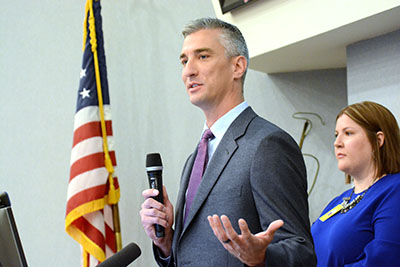
“At Pantex, you have a great emergency infrastructure here and you folks know that you are dealing with one of the most sensitive activities in the national nuclear enterprise,” said Jay Tilden, Associate Administrator and Deputy Undersecretary for Counterterrorism and Counter Proliferation. “There’s a certain level of safety here and procedural control that is exceptional. So, the idea that we would even have an accident is pretty low.”
“The NNSA must always be prepared for an emergency of any kind,” Tilden said. “Going through an exercise like NUWAIX 2019 is critical because it’s a complicated scenario requiring a lot of moving parts. And if we don’t exercise it, we may not be ready.”
There were approximately a thousand participants in the exercise, including hundreds of controllers and evaluators. Carson County Judge Daniel Looten, who participated in the exercise, said over the years he has come to know the Pantex emergency personnel through monthly meetings and mutual aid events.
“That trust and bond exists. I’m very secure to know that my citizens in Carson County are being very well protected and the people out here at Pantex do all they can to keep us safe,” Judge Looten said.
Throughout the exercise and tours, visitors were impressed with Pantex’s emergency preparedness. The objective of the event was met in that it gave the teams a chance to determine best practices and possible improvements.
For more images of NUWAIX 2019, see the Pantex Facebook site.